Dying as performance
What Are You Going ThroughDying as performance names the pressure to make death look and sound a certain way, even when fear, illness, and uncertainty resist any orderly script. The friend wants to meet death with dignity rather than panic, yet her account of terminal illness, the narrator’s memory of a support-group story, and the practical disorder surrounding the friend’s plan all expose the gap between an idealized role and lived experience. The concept also implicates those who witness death: they, too, monitor their words and feelings, trying to perform an acceptable response.
The Ideal of Composure
The friend imagines a good death as one without severe pain or loss of control, marked instead by poise and dignity. Her questions about how rarely such a death occurs suggest that this ideal is not merely a private preference; it is a standard against which actual dying can seem like failure. She fears becoming overwhelmed by anger or self-pity, and insists that she will not endure a death defined by anguish. The force of this resolve lies in its double meaning: it expresses a wish for control while revealing how much she fears losing it.
That ideal remains important even when the friend’s experience departs from it. She tells the narrator that she wanted peace, but that events have become a humiliating farce rather than the quiet ending she had imagined. The contrast does not show that her earlier wish was insincere. It shows how an expectation of composure can become an additional burden when circumstances refuse to cooperate. The desired performance and the experience itself pull in opposite directions.
Speaking for an Audience
The friend’s podcast makes this tension public. A social worker asked her to record answers about terminal illness, and afterward she regretted how she sounded. The narrator finds the recording less extreme than the friend had described, but notices moments that make her uneasy. She suspects the friend’s regret concerns her tone: she did not want to seem angry or bitter, and treated visible emotion about her own death as unbecoming. Even near the end, she clings to an image of stoical poise.
The narrator’s listening is itself morally complicated. She catches herself wishing the podcast were more interesting, then feels guilty for that reaction. Her discomfort leads her to suspect that people speaking about illness may offer what an audience considers acceptable rather than what they truly feel. The issue is not simply whether a speaker tells the truth. It is whether the speaker believes certain feelings can be shown without losing dignity in the eyes of others. The podcast becomes evidence of how a dying person may edit herself for listeners, while the listener discovers that sympathy does not prevent impatience or embarrassment.
The friend’s account of a woman at a support group gives the problem another form. The woman tells a difficult story in a stiff, subdued manner, appearing to follow an unspoken script, yet the group listens closely. When she finishes, some members reject her interpretation and urge her to accept a more reassuring explanation. The friend sees this response as a refusal to face what the woman has said: the woman had named people and spoken about a truth others found difficult to accept, while the group buried that account beneath denial. The scene shows that performance is not only imposed on a speaker. An audience can also insist on a more comfortable story, rewarding composure or reassurance while resisting troubling testimony.
Roles Shared by the Living and the Dying
The narrator generalizes from these scenes to the idea that dying, like other parts of life, is a role people play. The thought troubles her because she doubts that a person is ever wholly free of an audience except when alone; dying makes solitude especially painful to imagine. In this account, the problem is not that the dying person is necessarily pretending. Rather, the person must navigate expectations about how fear, grief, and anger should appear, while other people decide which expressions they can bear to hear.
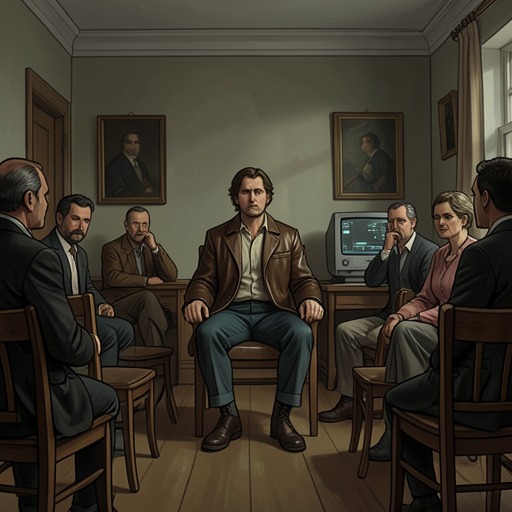
The narrator also faces a role of her own. The friend has said that the exact moment will not be announced, and that a closed bedroom door will signal what has happened. One morning the narrator finds the door closed earlier than usual. She panics, struggles to steady herself, and tries deep breathing when interrupted in her effort to regain control. The scene places her in the position of witness before she knows what she is witnessing. The promised signal turns an ordinary feature of the friend’s room into a possible message, and the narrator’s fear cannot be made orderly simply because the plan has been described in advance.
Ordinary Tasks and the Limits of the Script
The book places this crisis beside small routines rather than offering routine as a cure. The narrator thinks about grocery shopping and the need to make a list. Elsewhere she remembers times when cleaning a bathroom or completing a small task helped her endure anxiety and depression, and when a quiet work break with a packed sandwich and fruit made another day seem possible. Such acts can provide a moment of steadiness, but they do not resolve the demands of illness or turn grief into a sequence of manageable steps.
The friend reflects that childhood happiness can gather around one anticipated wish, whereas adult life rarely permits that single-minded fulfillment. That observation sits uneasily beside the wish for a good death: both desire and expectation become more complicated with age, and no single image can contain the whole experience. At the close, the narrator’s grocery bags hold eggs, bread, salmon, kale, and ice cream the friend will not eat. The ordinary purchases remain, but their meaning has changed. The narrator imagines eating too much, then finds herself on a park bench, light-headed and afraid to stand, worrying about the melting ice cream and spoiling fish. In that unresolved moment, death has no polished final tableau. The groceries, the bodily uncertainty, and the narrator’s panic outlast the ideal of composure, making the performance visible precisely where it breaks down.